
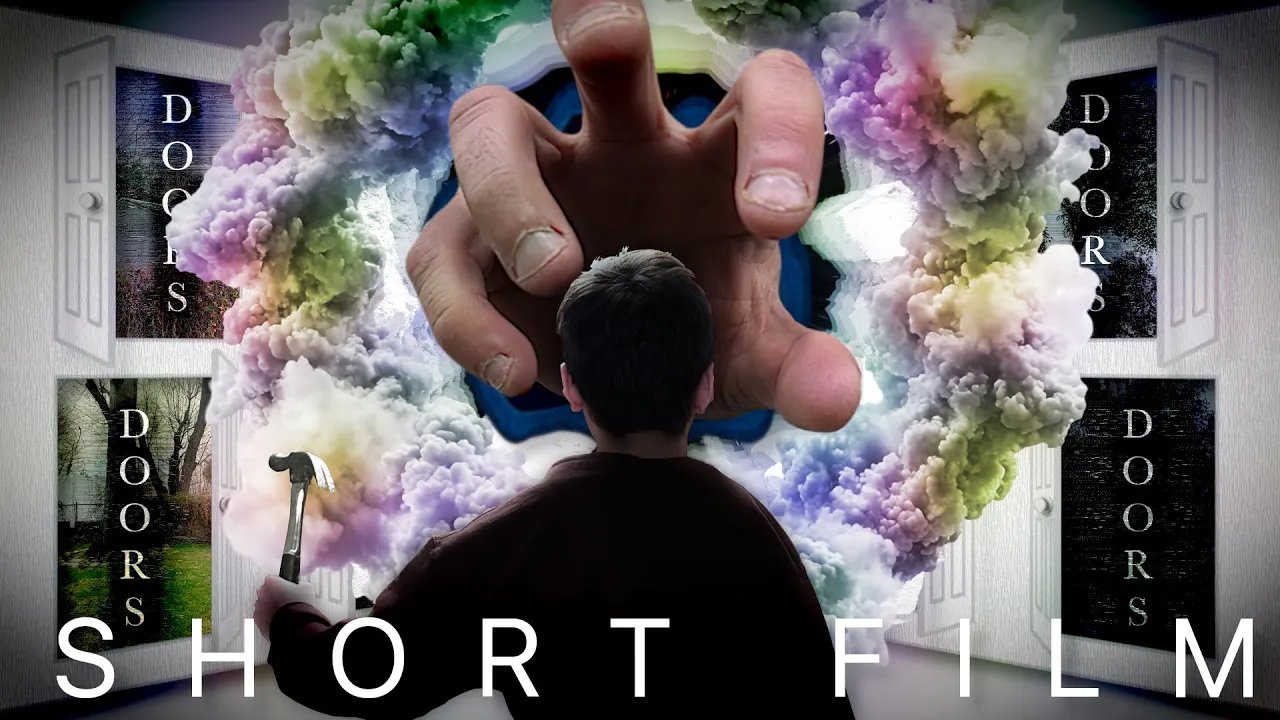
The Concept
Eight doors. Eight worlds. One continuous journey.
Doors is built around a deceptively simple structural idea: what if a door was not just an entrance, but a portal into an entirely different reality? Each of the film's eight doors functions as a gateway between scenes — and between visual languages. The hallway sections are shot in grayscale, drawing directly from Chuck Close's photographic work. The door openings transition to color, each one representing a different original photograph brought to life in video form.
Elements carry over from one door to the next. A hammer taken from one scene is used to break through another. A subject escaping one door runs directly into the next. The film is not a series of disconnected vignettes — it is a single continuous journey that happens to pass through eight different worlds.
Influence
Chuck Close and the power of extreme contrast.
The artist selected for this project was Chuck Close, whose grayscale portrait photography is defined by the tension between extreme highlights and extreme darks. What Close achieves with a white background and a near-disembodied subject is an almost ethereal effect — the figure exists in a monotone void, and the contrast between light and shadow becomes the entire emotional register of the image.
Close's use of negative space also informed the film's visual structure. In one of his portraits the white background recedes so completely that the subject appears to float. In another, the dark background makes the highlights on the face burn with an almost supernatural intensity. Both approaches were translated into the hallway sequences in Doors — the grayscale sections use negative space and stark contrast to create that same sense of unease before each door opens.
The Storyboard
Planned door by door before a single frame was shot.
The film was storyboarded on individual note cards before production began — each door assigned its own card with a description of the action inside. This level of pre-production planning was essential given the complexity of linking eight scenes through a single continuous visual thread.
Door 1
Walk out, look around, turn back open.
Door 2
Open. Grab hammer on desk.
Door 3
Man runs out and past camera.
Door 4
Closes on its own. Man opens and it's the sky. Gets pushed.
Door 5
Man falls out of ladder and lands on floor.
Door 6
Opens up to be outside — finished tree house. Man goes through door.
Door 7
Man comes out of here and runs with the hammer to break down door. Drops hammer.
Door 8
Man looks around in darkness. Then door silhouette turns white.
Key Decisions
What made the film work.
Grayscale to Color Transitions
Hallway sequences in grayscale, door openings in color. This visual grammar trains the viewer quickly — monochrome means between worlds, color means inside one. The transition is the threshold.
Continuity Objects
The hammer travels across scenes. Characters run out of one door and into another. These throughlines give the film coherence across eight completely different visual environments — and reward attentive viewers.
Doors as Portals
Rather than treating doors as transitions, the film treats them as the subject. Each door is a world of its own, with its own logic and visual language. The architecture of the film is the story.
Chuck Close's Negative Space
The grayscale hallway sequences use negative space and extreme contrast the way Close uses them in his portraits — to create a sense of psychological weight before the color world opens.
Reflection
What this film proved.
Doors proved that pre-production planning at the shot level — storyboarding each scene on its own card before touching a camera — makes production significantly more efficient and the final edit more coherent. The film's ambition, linking eight distinct visual worlds through a single continuous thread of objects and characters, required that level of structure before it could afford to be spontaneous.
The influence of Chuck Close was not decorative. It shaped the visual grammar of the entire film — the decision to shoot the hallways in grayscale was a direct translation of Close's approach to contrast and negative space into a moving image context. That kind of thoughtful application of influence, rather than surface-level imitation, is what elevates a student film into genuine creative work.