
The Concept
A real treehouse, torn apart and rebuilt on paper.
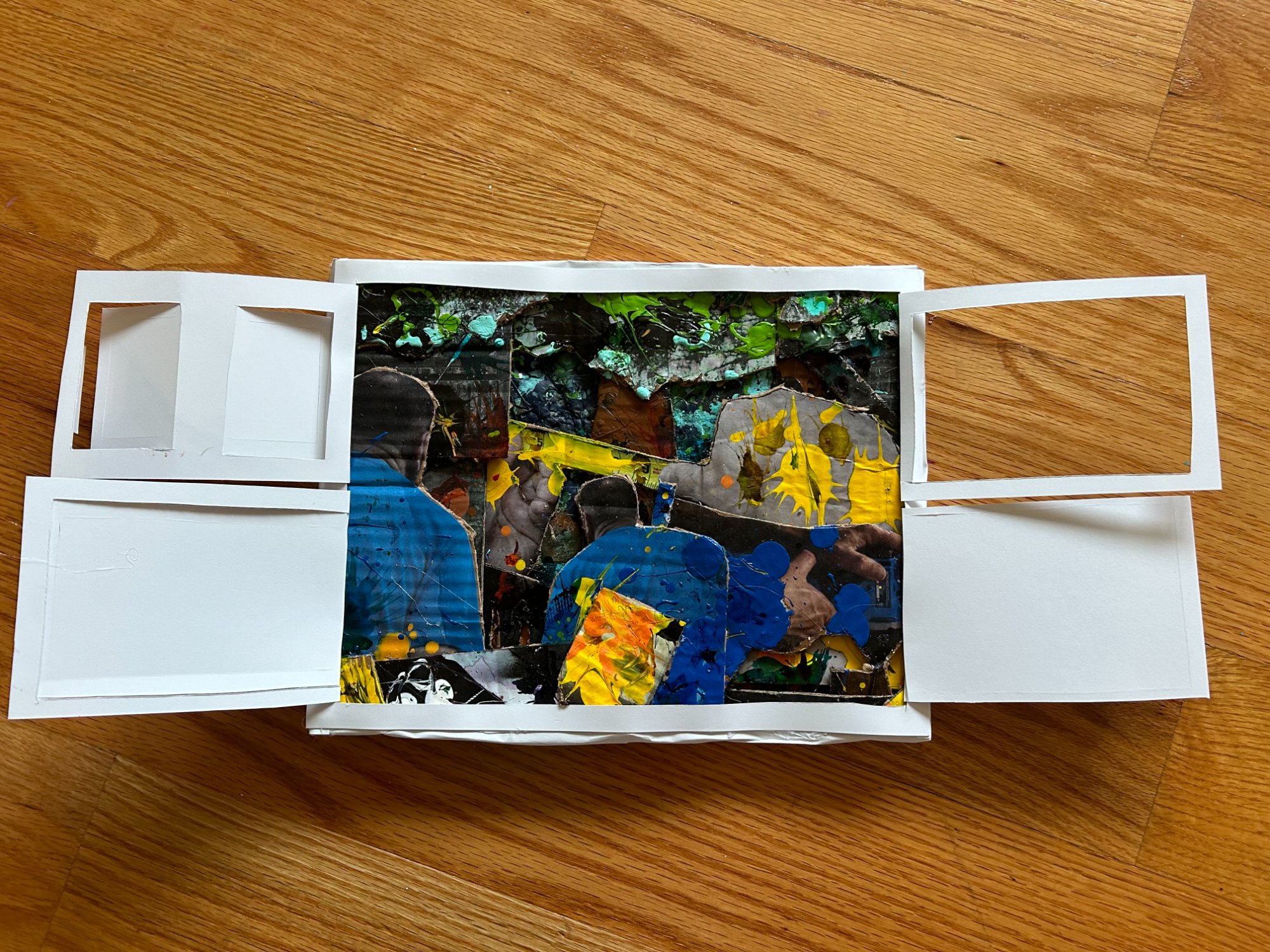
Mural began with a subject that was already personal — a treehouse and the tools and people involved in building it. Original photographs were taken on location: the tree itself being measured, the tools laid out on the workbench, a man working at the top of the structure in the late afternoon light. These images became the raw material for a collage that would not reproduce them faithfully but break them apart.
The goal was to run the subject through Ferris's visual language — tearing and patching the photos, adding colored paper and acrylic, and building a surface that felt like his work rather than just a record of what I photographed.
Influence
Keltie Ferris and the patchwork surface.
Ferris's work operates through rapid repetition of color and pattern, producing a surface that reads almost like a patchwork quilt from a distance but reveals individual geometric forms up close. What is most striking about it is that no individual color is ever lost — you can follow a single hue through the entire composition and trace its path from edge to edge. Colors and shapes function together as the design element of line, running vertically and diagonally and creating movement across the canvas.
He uses oil and acrylic, smearing each pattern into the next so they blend at the edges. The shapes are readable on their own but harder to pull apart once the whole thing comes together. That tension between clear and chaotic was what I was going for with Mural.
Process
From photograph to torn surface to painted collage.
Production began on location with a series of photographs documenting the treehouse project — the structure itself silhouetted against the sky, close-ups of the tree bark being measured with a tape, the drill and tools arranged on the workbench, and the builder at work at height. These were printed and brought into the studio as physical objects.
Each photograph was then cut and torn — some elements excised cleanly, others ripped deliberately to leave irregular edges. Pieces of colored Coloraid paper were added and soaked, torn and layered alongside the photographic fragments. Acrylic paint was applied directly to sections of the developing collage, smearing color across the boundaries between photograph and paper in the manner Ferris uses oil to blur one pattern into the next.
The final assembled collage was mounted with the white framing structure intact, giving the piece the quality of a door or a window — an object that frames and contains rather than simply displays.
Key Decisions
What shaped the final piece.
Tearing Over Cutting
Deliberate tearing of the photographs produced the irregular, patched edges that mirror Ferris's smeared boundaries. A clean cut would have produced borders — tearing produced transitions.
Acrylic Paint Integration
Painting directly onto the collage surface — rather than painting and then collaging — allowed the paint to function as a unifying element, pulling the photographic fragments and colored paper into a single surface.
Colored Paper as Color Field
Coloraid paper provided the flat color zones that give the collage its patchwork geometry. Like Ferris's repeating color patterns, individual colors remain traceable across the whole composition.
White Frame Structure
Mounting the collage within a white frame structure created a sense of the piece as a found object — a window into the subject rather than a reproduction of it.
Reflection
What this piece proved.
Mural proved that the most direct route to a strong mixed-media piece is to commit fully to the source of inspiration at the material level. The decision to tear rather than cut, to paint directly rather than mount separately, to use real photographs of a real place rather than invented imagery — each of these choices brought the piece closer to the specific quality of Ferris's work. The collage does not look like a Ferris painting. But it feels like one — and that is the harder thing to achieve.